
arguments 这种类数组,如何遍历类数组?
参考答案:
类数组对象
所谓的类数组对象:
拥有一个 length 属性和若干索引属性的对象
举个例子:
var array = ['name', 'age', 'sex'];

var arrayLike = {
    0: 'name',
    1: 'age',
    2: 'sex',
    length: 3
}
即便如此,为什么叫做类数组对象呢?
那让我们从读写、获取长度、遍历三个方面看看这两个对象。
读写
console.log(array[0]); // name
console.log(arrayLike[0]); // name

array[0] = 'new name';
arrayLike[0] = 'new name';
长度
console.log(array.length); // 3
console.log(arrayLike.length); // 3
遍历
for(var i = 0, len = array.length; i < len; i++) {
   ……
}
for(var i = 0, len = arrayLike.length; i < len; i++) {
    ……
}
是不是很像?
那类数组对象可以使用数组的方法吗?比如:
arrayLike.push('4');然而上述代码会报错: arrayLike.push is not a function
所以终归还是类数组呐……
调用数组方法
如果类数组就是任性的想用数组的方法怎么办呢?
既然无法直接调用,我们可以用 Function.call 间接调用:
var arrayLike = {0: 'name', 1: 'age', 2: 'sex', length: 3 }

Array.prototype.join.call(arrayLike, '&'); // name&age&sex

Array.prototype.slice.call(arrayLike, 0); // ["name", "age", "sex"]
// slice可以做到类数组转数组

Array.prototype.map.call(arrayLike, function(item){
    return item.toUpperCase();
});
// ["NAME", "AGE", "SEX"]
类数组转数组
在上面的例子中已经提到了一种类数组转数组的方法,再补充三个:
var arrayLike = {0: 'name', 1: 'age', 2: 'sex', length: 3 }
// 1. slice
Array.prototype.slice.call(arrayLike); // ["name", "age", "sex"]
// 2. splice
Array.prototype.splice.call(arrayLike, 0); // ["name", "age", "sex"]
// 3. ES6 Array.from
Array.from(arrayLike); // ["name", "age", "sex"]
// 4. apply
Array.prototype.concat.apply([], arrayLike)
那么为什么会讲到类数组对象呢?以及类数组有什么应用吗?
要说到类数组对象,Arguments 对象就是一个类数组对象。在客户端 JavaScript 中,一些 DOM 方法(document.getElementsByTagName()等)也返回类数组对象。
Arguments对象
接下来重点讲讲 Arguments 对象。
Arguments 对象只定义在函数体中,包括了函数的参数和其他属性。在函数体中,arguments 指代该函数的 Arguments 对象。
举个例子:
function foo(name, age, sex) {
    console.log(arguments);
}

foo('name', 'age', 'sex')
打印结果如下:
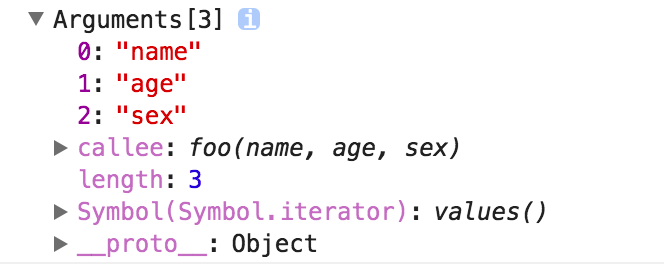
我们可以看到除了类数组的索引属性和length属性之外,还有一个callee属性,接下来我们一个一个介绍。
length属性
Arguments对象的length属性,表示实参的长度,举个例子:
function foo(b, c, d){
    console.log("实参的长度为:" + arguments.length)
}

console.log("形参的长度为:" + foo.length)

foo(1)

// 形参的长度为:3
// 实参的长度为:1
callee属性
Arguments 对象的 callee 属性,通过它可以调用函数自身。
讲个闭包经典面试题使用 callee 的解决方法:
var data = [];

for (var i = 0; i < 3; i++) {
    (data[i] = function () {
       console.log(arguments.callee.i)
    }).i = i;
}

data[0]();
data[1]();
data[2]();

// 0
// 1
// 2
接下来讲讲 arguments 对象的几个注意要点:
arguments 和对应参数的绑定
function foo(name, age, sex, hobbit) {

    console.log(name, arguments[0]); // name name

    // 改变形参
    name = 'new name';

    console.log(name, arguments[0]); // new name new name

    // 改变arguments
    arguments[1] = 'new age';

    console.log(age, arguments[1]); // new age new age

    // 测试未传入的是否会绑定
    console.log(sex); // undefined

    sex = 'new sex';

    console.log(sex, arguments[2]); // new sex undefined

    arguments[3] = 'new hobbit';

    console.log(hobbit, arguments[3]); // undefined new hobbit

}

foo('name', 'age')
传入的参数,实参和 arguments 的值会共享,当没有传入时,实参与 arguments 值不会共享
除此之外,以上是在非严格模式下,如果是在严格模式下,实参和 arguments 是不会共享的。
传递参数
将参数从一个函数传递到另一个函数
// 使用 apply 将 foo 的参数传递给 bar
function foo() {
    bar.apply(this, arguments);
}
function bar(a, b, c) {
   console.log(a, b, c);
}

foo(1, 2, 3)
强大的ES6
使用ES6的 ... 运算符,我们可以轻松转成数组。
function func(...arguments) {
    console.log(arguments); // [1, 2, 3]
}

func(1, 2, 3);
应用
arguments的应用其实很多,在下个系列,也就是 JavaScript 专题系列中,我们会在 jQuery 的 extend 实现、函数柯里化、递归等场景看见 arguments 的身影。这篇文章就不具体展开了。
如果要总结这些场景的话,暂时能想到的包括:
- 参数不定长
- 函数柯里化
- 递归调用
- 函数重载 ...
题目要点:
在 JavaScript 中,arguments 对象是一个类数组对象,它提供了访问函数参数的索引和长度。虽然它不是真正的数组,但可以通过一些方法来遍历它。
以下是几种遍历 arguments 对象的方法:
使用 for 循环:
javascriptfunction example() { for (var i = 0; i < arguments.length; i++) { console.log(arguments[i]); } } example(1, 2, 3);使用 forEach 方法: 首先将
arguments对象转换为数组,然后使用forEach方法遍历。javascriptfunction example() { Array.prototype.forEach.call(arguments, function(value, index) { console.log(value); }); } example(1, 2, 3);使用 for...of 循环:
for...of循环可以直接遍历类数组对象。javascriptfunction example() { for (let value of arguments) { console.log(value); } } example(1, 2, 3);使用 Object.keys(): 使用
Object.keys()方法获取arguments对象的键(索引),然后遍历这些键。javascriptfunction example() { Object.keys(arguments).forEach(function(key) { console.log(arguments[key]); }); } example(1, 2, 3);使用 Array.from(): 将
arguments对象转换为真正的数组,然后使用数组的方法进行遍历。javascriptfunction example() { Array.from(arguments).forEach(function(value) { console.log(value); }); } example(1, 2, 3);